

The original plan
The company building the Hinkley Point C nuclear power plant in southwest England had originally been given planning permission in 2013 for a scheme with low velocity cooling water intake heads and a fish return system to minimise the numbers of fish getting sucked into the plant's cooling water system. It also involved having 280 underwater speakers to blast out noises - sometimes referred to as a ‘fish disco’ - to keep fish away from the intake areas.
However, EDF later said that the "fast-flowing tides and poor visibility posed significant risks for divers" and instead it was considering replacing the acoustic fish deterrent plan and instead creating up to 900 acres (324 hectares) of saltmarsh in environmental mitigation. However, that plan faced local opposition in community consultations, and legal challenges threatened to add to delays for the nuclear power plant project.
The new acoustic fish deterrent system
In March 2025 EDF announced that trials were beginning on an "innovative" new type of acoustic fish deterrent that it had previously not known about. It involves using ceramic transducers to make targeted very high-frequency sound and was a fairly new technology deployed in the fishing industry to reduce by-catch and had not been considered for use for a power station before.
The company said it would not require a lot of power, so high-voltage power cables would not be needed and it can be lowered into place and maintained from the surface without the need for divers.
EDF said that the high-frequency system would be tuned to "maximise the effectiveness of fish deterrence whilst minimising impacts on larger marine mammals like seals and dolphins".
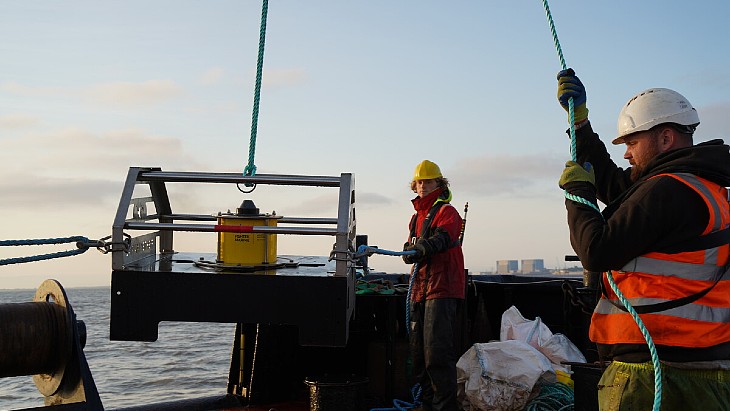
The new system can be lowered from surface (Image: EDF)
The trials update
EDF has now reported that 鈥痶he sea trials鈥�"have been successful and show the system is highly effective at keeping鈥痶argeted鈥痜ish鈥痵pecies鈥痑way from Hinkley Point C's water intake tunnels.鈥疐or example, testing of tagged鈥痶waite鈥痵had showed that after the acoustic fish deterrent was turned on, only one tagged鈥痵had came within鈥�30 metres of the intake heads. This compares with 14鈥痵had seen in the same area without the system turned on.鈥�疶he data suggests an effectiveness of more than 90%.鈥� Additional testing in tanks will continue throughout the first half of 2026".
David Clarke, fisheries scientist and marine ecologist at Swansea University, which carried out the trials, said early results showed the system "clearly working ... our results show that a large majority of the tagged shad avoid an area extending some 60 metres from the intake heads protected by the acoustic fish deterrent system".
Research by Swansea University also showed "that鈥痵almon,鈥痬igrating to the Atlantic,鈥痝enerally use鈥痶he main channel鈥�-鈥痺ell away鈥痜rom Hinkley Point C’s water intakes.鈥疘n two years, only two tagged salmon were detected within 1km of the intakes".
What are the other fish protection measures?
Power stations on the coast use seawater in their cooling water systems and Hinkley Point C is using "specially designed intake heads to slow the speed of water entering the cooling tunnels, allowing fish to escape from as close 2 metres in the 20-kilometre-wide channel". There is also a fish return system to transfer fish back to the sea. Taken together, EDF says that the GBP700 million (USD955 million) fish protection systems means the new plant will have more fish protection measures than any other power plant in the world.
What is the next step?
EDF says the research results will be鈥痵ubmitted鈥痜or regulatory consideration and approval later in 2026 as part of an application for system deployment.
Chris Fayers, Head of Environment at Hinkley Point C, said: "Because the system works even better than we had hoped, it means we鈥痗an meet鈥痑ll of our鈥� planning obligations鈥痑nd should not need to create 900 acres of saltmarsh as environmental compensation."
Pete Kibel, Managing Director, Fishtek Marine, said: "Building on our鈥痚xisting鈥痑coustic deterrent technology鈥痺e have now鈥痙eveloped鈥痑 highly effective system that will protect fish in the Severn Estuary and potentially鈥痓e an option for many more鈥痯ower stations throughout the world."
The Hinkley Point C project
Construction of Hinkley Point C - composed of two EPR pressurised water reactors of 1630 MWe each - began in December 2018, with unit 1 of the plant originally scheduled to start up by the end of 2025, before that was revised to 2027 in May 2022. In 2024, EDF announced that the "base case" was now for unit 1 being operational in 2030, with the cost revised from GBP26 billion (USD32.8 billion) to between GBP31-34 billion, in 2015 prices.
When complete, the two EPR reactors will produce enough carbon-free electricity for six million homes, and are expected to operate for as long as 80 years.


_51287.jpg)


