

The milestone was achieved three days after the go-ahead was given by the country's national atomic regulator.
A statement on the project's official Facebook account said: "This achievement is a significant step in Bangladesh's scientific and technological advancements and in the country's energy security. The Rooppur Nuclear Power Plant will play a crucial role in strengthening the country's energy security, diversifying electricity generation, and improving the development of low-carbon fuel systems.
"After achieving the required criteria, the test and safety verification process will be completed, and the reactor will be tested to operate at the minimum controllable capacity. If the subsequent tests are successfully completed, the national grid power supply operations will be advanced step by step."
The start-up of the unit followed talks in Moscow on Friday between Rosatom Director General Alexey Likhachev and Bangladesh's Science and Technology Minister Fakir Mahbub Anam.
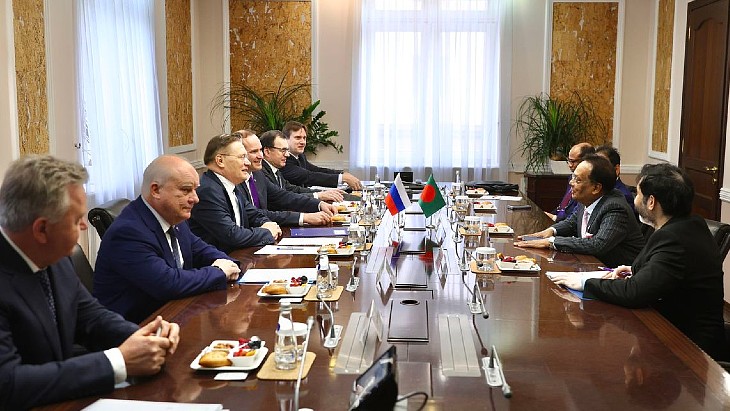
(Image: Rosatom)
According to Strana Rosatom, the in-house publication of Russia’s state nuclear corporation, the power start-up of the unit is scheduled for 20 November.
Before then there will be a series of tests and checks to ensure that all equipment and systems are working as designed. There will then be further tests and checks before the power start-up and as the power output is subsequently increased in stages.
Criticality means that the reactor has achieved a sustained nuclear chain reaction, with each fission event - when an atom of uranium in the fuel is split - releasing a sufficient number of neutrons to sustain an ongoing series of reactions.
Background
In February 2011 Russia's Rosatom signed an agreement for two reactors to be built at Rooppur, about 160 kilometres from the capital Dhaka, for the Bangladesh Atomic 抖阴传媒在线 Commission. The initial contract for the project, worth USD12.65 billion, was signed in December 2015. The Bangladesh Atomic Regulatory Authority issued the first site licence for the Rooppur plant in June 2016, allowing preliminary site works, including geological surveys, to begin.
Construction of the first unit began in November 2017. Construction of the second unit began in July 2018. They have an initial life-cycle of 60 years, with a further 20-year extension possible.
The first batch of nuclear fuel was delivered to the site in October 2023 - the moment that the site got its status as a nuclear facility. In March last year, Rooppur unit 1's turbine installation was completed, as were hydraulic tests to check the primary circuit systems and equipment, followed by hot functional tests. An operating licence was issued by the Bangladesh Nuclear Regulatory Authority on 16 April this year. The process of loading 163 nuclear fuel assemblies into Bangladesh's first nuclear power plant reactor was completed in May.
Meanwhile, Rosatom announced on Monday 12 October, that JSC Rosatom Automated Control Systems had completed the installation of automated process control systems at the first and second power units of the Rooppur plant. Likhachev said: "The Rooppur NPP is not only the largest project of cooperation between the Russian Federation and the Republic of Bangladesh, but also our flagship in the use of modern automation and control technologies. This is Rosatom's first foreign plant to implement the Operator Information Support System. The system increases response times and reduces operating costs."


_51287.jpg)


